High-Win-Rate "1:1" Trading in 0DTE Options
8 min read · by Adam
You will find many YouTube videos and opinions online about the optimal risk/reward for trade management. Even the occasional argument that trading based on an R:R at all is detrimental because discretionary trading should be evaluating the optimal stop loss dynamically.
The purpose of this article is to give you my opinion on this concept for 0DTE trading based on my experience.
First, let's look at the most common argument, aiming for a high risk/reward (ex. 1:5) so that you don't need to be right often to make money. The problem is that this advice assumes the only thing that matters is the math of payoff ratio. It ignores the actual product being traded, the path the market takes to get there, the frequency of large moves, the friction of spreads and slippage, and the reality that most intraday trades do not behave like smooth trend examples from a textbook.
For many 0DTE strategies, a high-win-rate, base-hit style framework is far more realistic and durable than trying to force every trade into a low-win-rate, home-run model (i.e., assuming you'll lose your entire premium and hoping for the best). This does not mean all 0DTE trades should be managed exactly the same way. It means the default should usually be small, frequent wins, while larger asymmetry should be earned only when the market proves the setup deserves it.
A larger R-multiple obviously lowers the win rate required for profitability. The flaw, however, is also obvious once you think about it in real market terms:
- Larger moves are less common than smaller moves
- 0DTE options decay extremely fast
- The path of the move matters more than the final destination
- Spreads, slippage, and poor fills matter a lot more than people admit
- Most traders execute higher-win-rate systems better than lower-win-rate ones
So yes, a 1:5 strategy can work mathematically. But it also demands something from the market: it demands that large, clean, extended moves happen often enough, and in a way that your product can monetize before decay and volatility shifts start working against you. And from our last article on NDX gamma ramps we know that is not always a possibility.
That is not automatically easier than a 1:1-style framework. In many cases it is much harder. A lot of traders think they are escaping the need for consistency by choosing a larger reward target. In reality, they are just shifting the consistency burden somewhere else. Instead of needing to be consistently right more often, they now need the market to consistently produce rarer, bigger moves.
0DTE is a special case
As you probably already know, 0DTE options are unusually sensitive to:
- time decay
- volatility shifts
- path of the move
- speed of follow-through
A trade can be "right" directionally and still underperform if the move is too slow, too choppy, or if implied volatility comes out of the contract before price extends through. Timing is extremely important. Many times in my trading I have identified the correct setup and move, but gamma and/or participation did not support it until a few hours later. If you simply let your trade get destroyed, then you're even more dependent on your setup playing out fully. If it doesn't, you lose big. Keep doing it a few more times, and your account is blown. So, let's talk about a few things you can do to help.
Smaller moves are statistically more available than large moves
Smaller moves happen more often than large moves. Markets spend more time making ordinary moves than extraordinary ones. If your strategy is built around capturing a frequent, realistic piece of the move, you are aligning your management with what the market statistically offers most often.
If your strategy is built around holding for large extensions every time, you are demanding lower-frequency outcomes from the market. That does not make larger targets wrong. It just means they should be reserved for situations where the market has clearly indicated them. For 0DTE, this is especially important. You cannot treat every trade like a swing-trade lottery ticket, though most will argue that's all they're good for (they're wrong…).
Why higher win rate matters more than people want to admit
There is a bad habit in trading culture of treating higher win rate as less sophisticated than lower win rate with bigger winners. It's nonsense. And, frankly, it's amazing how people don't understand this with as many "trading psychology" books it seems they are consuming these days.
Psychologically, traders usually perform better when they are not constantly sitting through losing streaks waiting for the occasional giant winner. A mathematically valid system is useless if the trader cannot execute it consistently.
And in 0DTE, that matters even more because:
- Premium moves fast
- Losses can stack quickly
- Spreads/slippage accumulate
- Chop can create repeated failed entries
Static vs. Modified 1:1
A static 1:1 risk/reward in 0DTE trading should look something like risking 20% to make 20%, or 30% to make 30%, and treating the trade the same from entry to exit. In this way, we force discipline and realize the fact that many valid 0DTE trades are best monetized as quick movements rather than clean trends.
That being said, there is also a more practical version that suits those setups where you do expect price to run for a while. This would be a modified 1:1, which means the trade begins as a static 1:1 but once the market proves that the move deserves continuation (ex. forward gamma ramp), then the stop can be raised and the take profit can be extended. Though, knowing when to do this and when not to do this is important (again, often influenced by live 0DTE GEX).
A simple compounding illustration
Assume the following:
- Starting balance: $3,000
- 1 trade per day
- Win rate: 80%
- Either a 30% take profit / 30% stop loss or a 20% take profit / 20% stop loss
- A fixed percentage of total equity is allocated each day
- Position size is recalculated off current equity after each trade
Under those assumptions:
- A 30/30 system has expected account growth per day of roughly 18% × position size
- A 20/20 system has expected account growth per day of roughly 12% × position size
So, assuming the same 80% win rate, the 30/30 structure has 50% more expectancy per trade/day than the 20/20 structure.
A very useful shortcut is this:
- 30/30 at 20% size has about the same expectancy as 20/20 at 30% size
- 30/30 at 10% size has about the same expectancy as 20/20 at 15% size
Expected account growth by day
As you can see, at the same position size, the 30/30 structure compounds more aggressively if the win rate truly remains the same.
30% Take Profit / 30% Stop Loss
| % of account used per day | 20 days | 50 days | 100 days |
|---|---|---|---|
| 5% | $3,589 | $4,695 | $7,349 |
| 10% | $4,286 | $7,320 | $17,861 |
| 20% | $6,086 | $17,584 | $103,062 |
| 30% | $8,589 | $41,606 | $577,009 |
| 50% | $16,813 | $223,073 | $16,587,122 |
20% Take Profit / 20% Stop Loss
| % of account used per day | 20 days | 50 days | 100 days |
|---|---|---|---|
| 5% | $3,381 | $4,046 | $5,457 |
| 10% | $3,808 | $5,447 | $9,889 |
| 20% | $4,821 | $9,820 | $32,145 |
| 30% | $6,086 | $17,584 | $103,062 |
| 50% | $9,621 | $55,260 | $1,017,906 |
This does not mean you should immediately use wider brackets or larger size. It simply shows that the blanket assumption that "1:1 cannot compound well" is false when the system has a high enough hit rate.
A wider 30%/30% bracket is clearly more powerful than a 20%/20% bracket if the win rate stays the same. But that does not automatically make it the better practical choice in every situation. Wider brackets increase equity volatility, make losing streaks hit the account harder, and require more from both the setup and the trader. That's why the most important decision is often whether the trade deserves full size in the first place.
And, if you think I'm being too generous with an 80% win rate… keep studying ;)
The hidden issue: losing streaks still happen
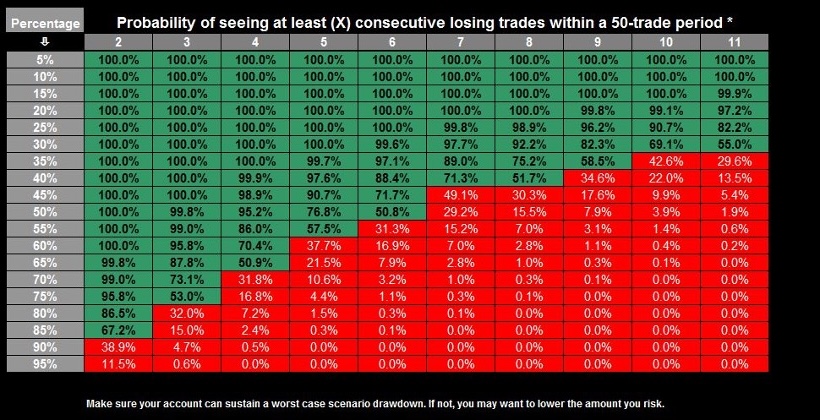
Even with an 80% win rate, losing streaks are not rare in a meaningful sample. This sounds counterintuitive, but it matters a lot for 0DTE trading because the combination of high sizing and consecutive losses can do real damage before the edge has time to reassert itself.
This is also where the law of large numbers matters. Over a large enough sample, a strategy's realized results should begin to converge toward its true expectancy. But in the short run, outcomes can still cluster in uncomfortable ways. A high-win-rate system can still go through frustrating streaks of losses before the edge fully expresses itself.
Your biggest worry in trading should be whether the account can survive the inevitable clusters of losses without causing emotional or structural damage.
The chart below illustrates the probability of seeing at least X consecutive losing trades within a 50-trade sample at different win rates. The takeaway here is that a high win rate improves expectancy, but it does not eliminate drawdowns. Therefore, if you know a specific trade or setup is lower conviction, you should absolutely use lower size.
A setups vs. B setups
CONVICTION MATTERS. Not every setup deserves the same exposure. A lower-quality setup should not be given the same exposure as the higher-quality one.
My view is that A setups in a 0DTE options strategy should generally get:
- normal size
- something like 20–25% stop / 20–25% target
That still reflects a 1:1 structure, but gives stronger setups a bit more room for noise and a bit more expected movement.
For B setups, the cleaner default way is usually not to tighten the trade immediately to something like 10% SL/TP. The better adjustment is usually to reduce size first, while keeping the same bracket width.
Why? Because tightening from 20% to 10% does not just reduce risk, it also reduces opportunity and changes the behavior of the trade. If the setup is still valid but simply lower conviction, smaller size is often the better way to express that.