
From Small-Account Growth to Normal-Account Income in 0DTE Trading
August 15, 2026 · 15 min read · by Adam
The Foxchase Trading $3k Account Series ended almost exactly the way I knew it eventually could: $3,000 grew to more than $22,000, then a major drawdown brought the account back to around $6,300.
This was not my first time experiencing that type of equity curve. In spring 2025, while I was still in a much more experimental phase of my trading, I had a similar run from roughly $5,000 to $50,000 in a few months. At the time I traded a much simpler ICT-based approach centered largely on Fair Value Gaps, or FVGs, before eventually experiencing the same problem.
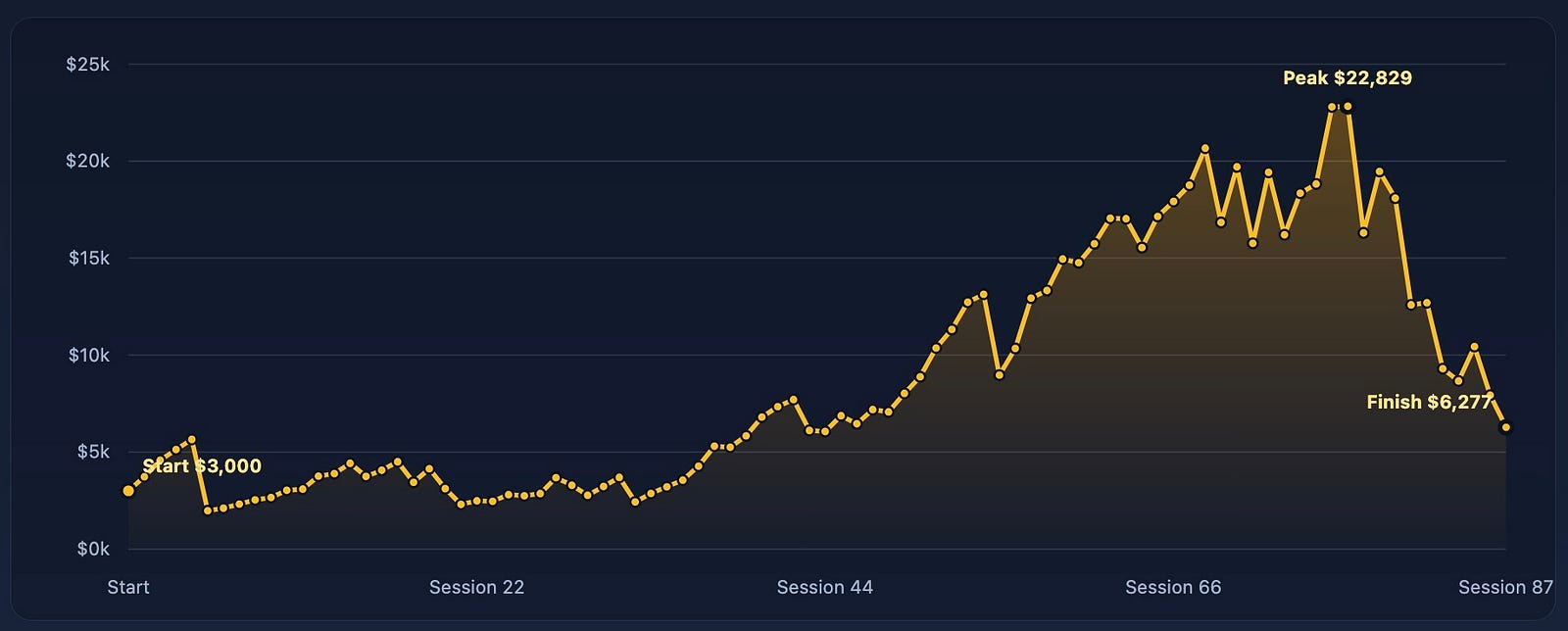
That equity curve is how a huge number of long 0DTE accounts end up, and it reinforces something I already knew very well about position sizing in 0DTE. Most traders write this off as an inherent flaw of long 0DTE trading. I want to explain how that risk can be mitigated through better sizing, selectivity, and profit withdrawals.
The series started as a live proof of concept for the discretionary 0DTE framework outlined in my book, 0DTE: Regimes, Volatility, and Execution. Importantly, the run from $3,000 to more than $22,000 was not the result of one or two lucky home-run trades. The Small Account Series documented every trading day individually, and the growth came from consistently stacking winning days over time.
The series ultimately logged 87 trading days with a roughly 69% green-day rate. You can look through the entire archive yourself, including the wins, losses, execution mistakes, screenshots, setups, and reasoning behind each day.
The account came within a few thousand dollars of the original $25,000 goal, which was itself somewhat arbitrary and based around the previous pattern-day-trader minimum-equity requirement. That framework has since been replaced by new intraday margin rules, although brokerage implementation can vary during the transition period. It is largely irrelevant to me anyway because I personally use and advocate for cash accounts in 0DTE trading. Settled-cash limits naturally discourage overtrading and make it much harder to keep clicking after a few bad trades.
Inevitably, a cluster of execution mistakes, low-participation sessions, difficult volatility, and simply too much exposure caused a major drawdown from the peak. The account still finished more than 100% above its original $3,000 balance, but frankly, that is not the point.
The important part is realizing that a small account trying to compound and a larger account trying to generate consistent income are not solving the same problem. Naturally, continuing to do what works over and over makes sense.
But eventually the math of drawdown starts mattering more than the math of maximum growth. For a broader review of that math, see High-Win-Rate “1:1” Trading in 0DTE Options. The Small Account Series ended up showing both sides of that pretty clearly.
The first distinction: growth mode vs. income mode
In a small account, remembering that “small account” is relative to the individual, the main objective is compounding. In that phase, aggressive deployment can make sense because:
- The account is still small enough that meaningful growth requires more concentration.
- You are intentionally accepting more volatility.
- The account is not yet being relied on as a major income-producing asset.
- The absolute dollar consequences of a large percentage drawdown are still relatively small.
- You are proving that your system, or at least parts of it, actually works.
Once the account, and your system, becomes meaningful enough that you care about producing income from it, the job of the trading account should change. More attention should go toward:
- Preserving capital.
- Generating more consistent income.
- Reducing unnecessary account swings.
- Avoiding drawdowns that take forever to recover from.
- Actually withdrawing profits instead of leaving every dollar exposed to the next trade.
Therefore, deployment needs to come down as the account grows.
For a normal income-producing account, sizing cannot be based only on how confident you are in the setup. It also has to be based on what happens if you hit a bad losing streak.
Why this matters even if you have a profitable strategy
One mistake I have certainly made in the past is thinking that a high win rate, for whatever evaluation period, gives me permission to size however I want. Nope.
A high win rate certainly helps expectancy, but losing streaks are still inevitable over a large enough sample, with their frequency depending on your actual win rate. Most of us are familiar with the math and how quickly it gets ugly:
- A 20% loss requires a 25% gain to recover.
- A 30% loss requires about a 43% gain.
- A 50% loss requires a 100% gain.
- A 70% loss requires about a 233% gain.
Compared with traditional shares trading, 0DTE options make large percentage gains possible, but that does not make recovering from a massive drawdown desirable or easy. You still do not want a wildly volatile equity curve or an account that chops up and down for months, which the Small Account Series experienced early on.
A simple example using 20% bracket stops
Assume the default trade management is a 20% stop on the option position. Ignoring slippage for a moment:
| Account deployed | 20% position stop | Intended account risk |
|---|---|---|
| 25% | 20% | 5% |
| 50% | 20% | 10% |
| 75% | 20% | 15% |
| 100% | 20% | 20% |
Deploying 100% of the account does not necessarily mean you are trying to lose the entire account on that trade. If the 20% stop works properly, the intended loss is approximately 20% of the account. The key is setting the stop automatically when you enter with an OCO order. No mental stops. With 0DTE options, a 20% stop is still an intended loss rather than a guaranteed fill because fast moves and slippage can push execution beyond the stop price.
No doubt, this is still a huge loss per trade. If you lose 20% of the remaining account on each trade:
- After one loss: 80% remains.
- After two losses: 64% remains.
- After three losses: 51.2% remains.
- After four losses: 41.0% remains.
- After five losses: 32.8% remains.
Five straight losses puts you down roughly 67%. Even a strong strategy will experience losing streaks over a large enough sample.
This assumes you stick reasonably closely with the established strategy from which you derived the win rate, ideally validated through live paper trading or very small real-money sizing, such as one contract per trade. Deviating from a strategy is not necessarily bad. If my historical 70% win rate includes A+, A, and B setups, but my A+ setups have clearly demonstrated a higher win rate, I could take fewer total trades and focus primarily on A+ setups. Assuming that edge persists, this should increase the expected win rate of the trades I actually take and naturally reduce the probability of long losing streaks.
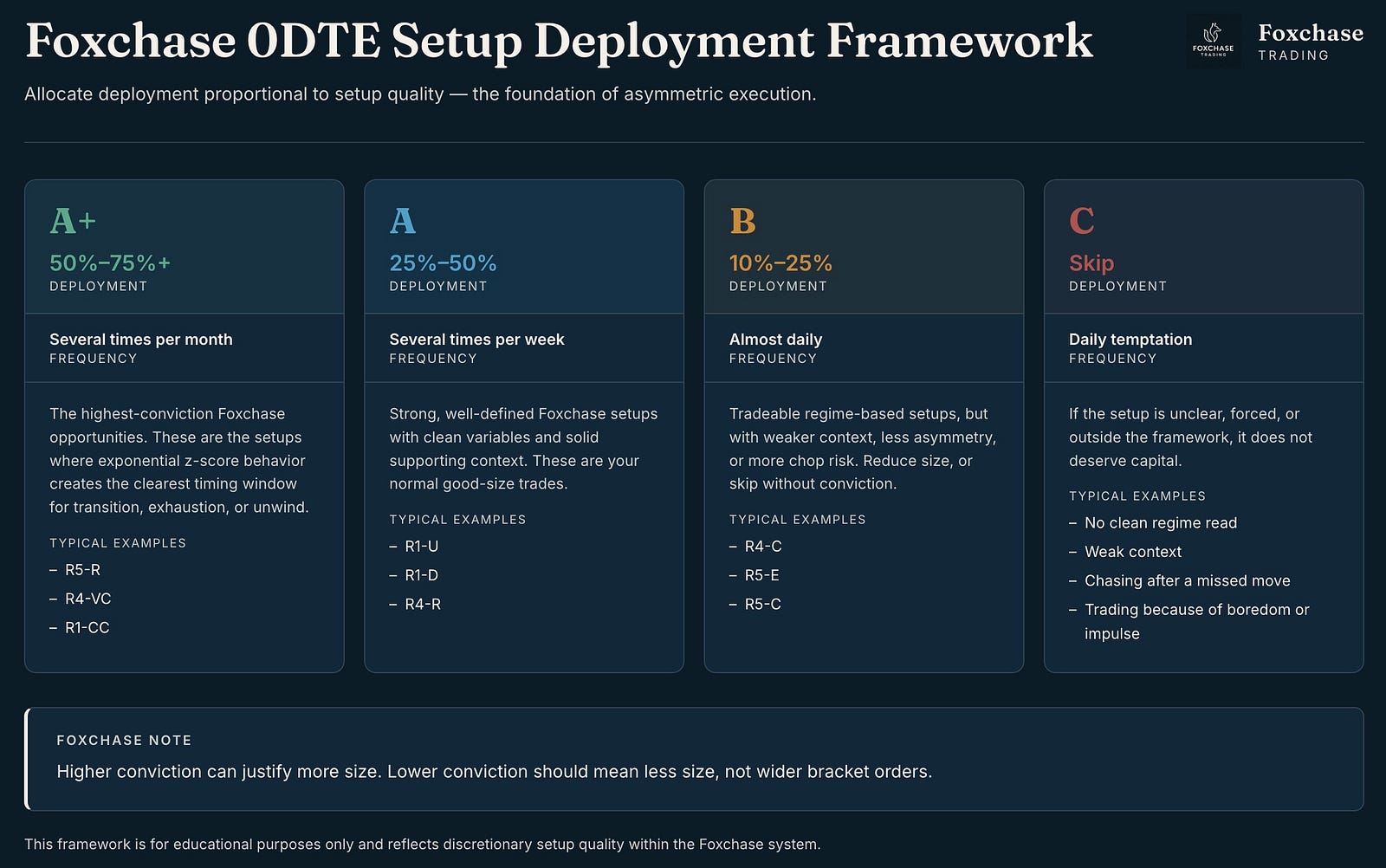
Position sizing should not be built around “How much can I make if this wins?” It should begin with “What happens to my account if I lose several trades in a row?”
Size backward from acceptable drawdown
Now assume your profitable strategy has grown what you consider a small account into one that could reasonably start producing income with less risk.
Earlier, we used a hypothetical strategy with a true win rate of around 70%. Even with that win rate, losing streaks remain inevitable. As shown in the previous article, over a 50-trade period a 70% win-rate strategy has about a 73.1% chance of seeing at least three consecutive losses, a 31.8% chance of seeing at least four, and a 10.6% chance of seeing at least five. A five-loss streak is therefore a reasonable stress test for an income-producing account.
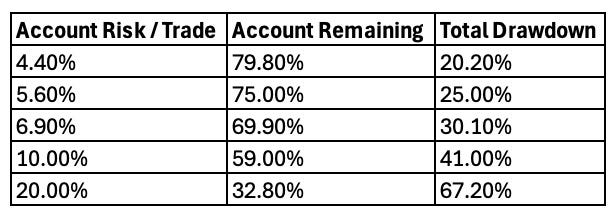
If account risk per trade is r, then after five straight losses the percentage of the account remaining is:
(1 − r)5
Working backward, if you only want approximately:
- 20% drawdown after five losses, account risk is about 4.4% per trade.
- 25% drawdown, account risk is about 5.6%.
- 30% drawdown, account risk is about 6.9%.
If you are still using a 20% stop on the option position, that works out to approximately:
- 22% deployment for a 20% five-loss drawdown.
- 28% deployment for a 25% five-loss drawdown.
- 34.5% deployment for a 30% five-loss drawdown.
One of the biggest lessons I took from the Small Account Series is this: once the account’s job becomes income generation and capital preservation, A+ setups can still justify larger sizing because of their higher expected win rate. But conviction alone should not determine size. Even A+ deployment should have a ceiling based on the drawdown you are willing to tolerate if several of those trades fail.
The missing piece: actually withdraw the profits
Reducing deployment and becoming much more selective about discretionary trades is only half of the change. Another lesson from the Small Account Series is probably even more obvious: at some point, you have to take the money out.
During the challenge, withdrawing profits would have defeated the purpose. The goal was compounding, so every dollar of profit stayed in the account and became available for the next trade. That is how $3,000 became more than $22,000. It is also why more than $22,000 was still sitting there exposed when the drawdown started. That makes perfect sense in growth mode.
At some point, we have to decide when growth mode should end. There is no universal dollar amount where a small account suddenly becomes a normal account. A small account is relative to the trader’s total available capital, income needs, and tolerance for drawdown. Likewise, your eventual income-account size should be determined separately. You must determine how much capital you actually need to generate your desired income while using a level of risk you can tolerate.
Maybe the answer is $25,000. Maybe it is $50,000, $100,000, or $500,000. But there is an important reality we must never forget: the market ultimately decides how much money is available to be made.
July was a good real-world example. Historically, July tends to be one of the lowest-volume periods of the year. That seasonally low participation, combined with a few execution mistakes, contributed heavily to the drawdown in the Small Account Series. Afterward, I reimplemented an improved version of my relative-volume checks and backtested them over that period. The results suggested that the filter would have helped avoid several lower-quality entries that caused losses.
You can set an income goal, but you cannot force the market to produce enough A+ setups to hit that goal on your schedule. Some weeks may offer several excellent opportunities. Other weeks may offer almost nothing. Trying to manufacture income from a low-quality environment is usually how traders end up taking B setups with A+ size.
Your account size should therefore support your income goals when good opportunities are present, not create pressure to extract a fixed amount from the market every day or month. It is another reason I advocate for having a much lower-risk, less volatile algorithm running in the background and/or contributing regularly to a traditional investment account.
Make the transition gradually
Suppose my eventual operating balance is $50,000. That does not mean I should aggressively compound $3,000 all the way to $50,000 under the exact same sizing rules and suddenly become conservative the moment I hit the target.
The transition should probably happen gradually. As the account approaches an amount of capital that becomes meaningful to preserve, deployment should start coming down, mediocre setups should disappear, and withdrawals can begin before the final operating-balance target is reached. If $50,000 is my eventual target, there is no reason to trade a $40,000 or $45,000 account with the same aggression used when the account was $3,000.
There is also no requirement that the small account bootstrap every dollar of the future income account. If you have outside capital available, the equation changes. A smaller live account can demonstrate that the strategy and your execution work under real conditions. Once demonstrated, additional capital can be deliberately allocated under the lower-risk income framework. All we are really trying to do with a small-account challenge is demonstrate that we can execute the strategy profitably with real money over a meaningful sample.
Once in income mode, I personally like the idea of keeping the intended operating balance relatively consistent and withdrawing profits weekly, biweekly, or monthly. Even daily can make sense after a particularly large win. If I decide $50,000 is the amount I want to trade and the account grows to $55,000, I do not automatically need to size the next trade from $55,000. I can withdraw some or all of that $5,000 and bring the account back toward the intended operating balance. That is what makes it an income-producing account.
If I intentionally decide to move from a $50,000 account to $75,000 or $100,000, that is different. The important part is that the increase should be intentional, not simply the automatic result of never withdrawing anything.
Growth mode: Compound profits and accept more volatility.
Transition mode: Gradually reduce deployment as the account becomes meaningful.
Income mode: Establish an operating balance, focus on the best setups, control drawdown, and actually pay yourself.
Looking back at the Small Account Series, this may be the most important difference. Compounding helped turn $3,000 into more than $22,000 very quickly. But because the entire point was to keep compounding, almost all those gains remained exposed when the drawdown came.
For the challenge, that was the point.
For an income-producing account, it should not be.
Final thought
Aggressive compounding is not inherently wrong. It serves the purpose of growing a small account quickly and can have very favorable results. At some point, though, you have to realize that the laws of the universe, meaning math, will eventually come around and punch you in the face, forcing you to shift your focus from endless, rapid account growth to actually benefiting from the capital you have built.
For anyone who wants to model this more concretely, I built the free Foxchase Risk & Sizing Planner. It can help estimate deployment, losing-streak drawdown, expectancy, contract sizing, and when SPY versus SPX may make more sense based on the intended setup size.
For a comprehensive look at how I approach discretionary 0DTE trading, see my book, 0DTE: Regimes, Volatility, and Execution: A Practical Operating System for Intraday Index Options Trading.